Showing posts with label conservation. Show all posts

To Lawn or Not to Lawn...That is Today's Question


Before reading this, you may want to check out the posts leading up to this finale of our Earth Week series...

Part One
Part Two
Part Three
Part Four

It's been portrayed as our patriotic duty. Much like Liberty Gardens or food rationing in World War II, we Californians are being told lawns are passe and we need to let them die to be good water users.

Funny thing is, we've been conserving water for years and still use a lot less than people around us. Now, partly because they couldn't be bothered to cut back, we have to cut even deeper and all eyes are on that semi-green patch in front of the house.


Part of me says, fine. Let it go.  You won't have to mow it anymore.  The other part of me says it'll be dusty, ugly, and the grass has other benefits besides looking nice and creating a soft place to step.

So what are the benefits of a lawn?  It creates habitat for bugs which feed the birds. It filters water going back to the aquifer. It keeps the dust down. It creates oxygen. It has a cooling effect on the air. It improves the value of a property.

What are the drawbacks? It takes water. In our case, about 10% of our monthly water. You have to mow it regularly. You have to do other maintenance such as feeding and de-thatching.

Now, looking at the pros and cons, what do I do?  

When a lawn goes dormant, such as in the cold of winter back east or the scorching heat of summer out here in the west, it doesn't really die and will sprout readily when fall rains come again.


I've cut back to where I still comfortably land in the water use guidelines and regulations to our state so I think I will continue until the lawn browns on its own when the summer heat gets too much for it. At that point, I will cut it off and wait for a wetter winter and fall to see how it comes back.

Sure beat mowing it every weekend this summer.

I hope you've enjoyed our Earth Week series and that it's helped you to be water-wise in your own gardening. Next time, it's back to our little patch of urban garden, our follies, and triumphs.


Darryl
Copyright 2015 - Darryl Musick
All Rights Reserved

The Drought Comes Home


We continue our exploration of the effect of the California drought for Earth Week. See our first, second, and third parts at the links.

As we've wound our way from the macro issues of California's drought, through the biggest uses, and tips to meet the mandated cuts in use, it's time to get to the nitty gritty...how does this impact our little garden out back?

My frequent readers should already know this is not my first trip to the drought rodeo. We've had several droughts since I remember my first severe drought around 1970.  I've always sought to get as much as I can with as little water as possible.


If a plant can't hack it with the little water I supply, it won't be invited back to be a member of the Cheapskate's garden. This has been my policy for many years so what is growing here, my little family of over 100 plants, have proven their non-thirsty ways.


Roses do very well here. Suprisingly (to me anyway), the very tropical plumeria plant is a true water miser and grows spectacularly here with just a glassful a day. Grapes are well known drought tolerators, especially red varieties, and orchids...with their water storing psuedobulbs..only need a good watering once or twice a week.


As I've outlined in our Poor Man's Sprinkler System post, I've installed a drip irrigation (and microsprinkler) system for our non-lawn plants. With the help of a two-station timer, I've honed the watering schedule to just the bare minimum these plants need to thrive.

From 5 minutes every three days in the dead of winter for our shady zone to 15 minutes a day for the hot, sunny zone in the summer, trial and error has given us the data we need to keep our water usage low while keeping the flowers, vegetables, and fruit production as high as we can get.


It's also good to have a bellwhether plant. For us, it's our guava tree.  When it starts to shrivel, I know I need to add water.  While still a pretty drought tolerant plant that provides pounds of edible fruit, it's also the thirstiest tree we have. Being the first to show signs of stress, it's a great indicator as to whether the rest of the garden is getting enough water or not.

Another non-expected aspect of the drought is all the wild animals coming down from the mountains behind our house. Last year, they devistated our crop-producing plants, highly effecting our harvests.


This year, we're doing our best to discourage those unwanted diners by caging our plants, hanging them up, or netting the fruit.  While those results are still pending, I'm confident this year will bring more of a harvest than the last.


The rain will come again but in the meantime, we've learned to live quite well with it and reducing our usage to the bare minimum while we do.

There's one big area left for us to take a close look at. Next time, we'll examine the lawn and what we can do about that big water sponge out front.


Darryl
Copyright 2015 - Darryl Musick
All Rights Reserved

Our Long Drought: Making Every Drop Count

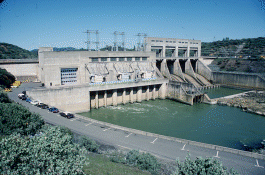
Picture courtesy of Wikimedia
Andrew Vargas under CC BY 2.0 license

In parts one and two, we looked at facts vs. myths in the big picture of the drought and analyzed where savings could be found. This time, we'll look at the ways urban (residential and industrial users) users can achieve that magical 25% cut in their water.

First, though, we must look at the fairness of this.


Not everyone in California has been letting the water run like there's no tomorrow. We've had droughts before and many, many long time residents have taken that to heart and cut their water use a long time ago. When we first moved into our house, we showed the sewer district that our water was at least 20% less than the average for our area and got a discount on our fees. We've lessened our water use by 30-50% depending on the time of the years for the last five years.

Now, us, and people like us are being asked to cut another 25%...same as the big water wasters. There's some big debates going on about the fairness of Governor Brown's mandatory cuts.

In the meantime, here are some things people can do to cut their water use...

Install a shut-off valve in the shower - Get wet, turn off the water, soap up, turn it back on to rinse to save a few gallons each time you wash.


Install a low flow toilet - The overwhelming majority of Californians already have one. You can also put a few bricks in the water tank for displacement so that not as much water is needed to shut off the valve.


Install drip irrigation and timers - This is easy to do and inexpensive. It also has the added benefit of freeing up some time when you no longer have to water the plants manually. See our "Poor Man's Sprinkler System' for more details.


Sweep - Don't hose down pavement.


Cut back on car washes - It's not a good thing to never wash your car but lessen the frequency and use a car wash that recycles water or use a hose with a trigger sprayer that you can turn off between soaping up and rinsing in your driveway.

Cut water runoff - adjust your sprinkler spray patterns so that you're only watering the plants...not the sidewalk and street.

Let it mellow - An old saying from our 70's drought, "if it's yellow, let it mellow; if it's brown, flush it down." Don't flush the toilet so much.


Turn it off - turn off the water while brushing teeth and shaving until you need to rinse.


Look for drought tolerant and low-water plants - your nursery can help you get plants that don't need too much water, like my roses that hardly take any at all or a grapevine (we'll delve into this in more detail in a future post).

Those are a few, got any more you'd like to add? Leave them in the comments below or at our Facebook page - The Cheapskate Urban Gardener. We'll add the best ones here.


Darryl
Copyright 2015 - Darryl Musick
All Rights Reserved

Water, Water Everywhere but Not a Drop Here


We continue our exploration of the California drought for Earth Week. See our first post here.


Just about a mile from the casinos of South Lake Tahoe, there's a Forest Service park where you can hike and get wonderous views of the lake, the forest, and Taylor Creek. It's a wonderful trail, beautiful really, where you can get lost from the nearby city.  Along the trail is a short detour. Follow it, and you'll end up in an underground chamber.

This is the Stream Profile Chamber, a pool where a portion of Taylor Creek has been diverted and a large, glass window allows visitors to watch the life underwater here. Trout, crawfish, perch, and more illustrate the absolute need for fresh water to flow in an ecosystem.


It also shows how much a change in water can alter this. Dam up a creek or river and what happens to all that life underwater? What about the animals that feed on these creatures? What does it take to replace it?

Hence the dilemma facing our state. Cut back on agricultural water and what happens to the crops that depend on it? How do you replace that food source? What happens to the oxygen producing, waste water filtering abilities of our lawns if we let them fallow? What about the employees of businesses that rely on a source of water?


More than half of the nation's fruits, vegetables, and nuts come from California. The top three crops are almonds, dairy, and dairy products. Grapes are also huge here. The state exports over $20 billion dollars worth of agricultural products and the total production approaches $50 billion per year.


Since 1980, California agriculture has lessened its water use by about 5% while increasing crop yields at the same time. Farmers have utilize methods such as drip irrigation, tailwater return systems, irrigation scheduling, canal lining, water banking, and remote monitoring to increase water efficiencly.

Still, there are calls for agriculture to share in the current pain of the state's new 25% mandatory reduction.  Of course, that means less and more expensive food for the entire country not to mention killing jobs in an already high-unemployment area of the state.

Some restaurants in particularly hard-hit areas say they have to switch to disposable plates and utensils because they don't have enough water to wash dishes. Of course, that impacts landfills.


Hydroelectric dams need water to generate electricity, when they go offline, fossil fueled generators have to take their place.  River guides join the unemployment lines, as do car wash employees, gardeners, and more.

This is to show that knee-jerk reactions to just cut everybody's water have real-world consequences. It's all part of a big ecological puzzle and has to be carefully considered and implemented.

All that being said, the state does not have enough water to satisfy the long term demand if rain relief does not come soon.  Now the question is how to cut and who do we cut from.


It's hard to say which industries are water hogs. We have pretty good agriculture data and the recent fracking controversy shows that industry using 0.00062% of the state's water each year. Car washes mostly use recycled water. Other than that, it's hard to pinpoint various industries use of water (which is included in the residential alotment).


The other very large alotment of California water is for environmental uses. These are determined by court orders, legislation, and other factors and are generally non-negotiable without much litigation and legislation. Water savings here are generally considered 'off the table' and leaves us with the residential customer taking the hit.

We'll look at ways to whittle that 12% down to 9%, which is what the state is telling us we must do, on the next post.


Darryl
Copyright 2015 - Darryl Musick
All Rights Reserved

Sources: Bay Area Science Forum
California Department of Water Resources
Metropolitan Water District
Bakersfield Californian

Los Angeles Times
Washington Post

Saving the Planet, One Drop at a Time


It's Earth Week and we here at the Cheapskate Urban Gardener are in full agreement that we need to pull together to save our home.  Since we're in California and in a severe drought, we're going to focus on that, try to sort the myth from fact, and try to determine how we can be effective and responsible gardeners in these dry times.

We're going to start off with the big picture and work our way down to the effects on our local garden.

The headlines are scary...California has less than a year left of water; almonds are sucking the state dry; environmentalists won't let us use water because of the damage to insignificant species; farmers take 80% of the water and won't do anything to help.

But those are just scare headlines written to sell papers.  I've been going through weather statistics, state water board sites, and other sources to try to separate fact from scary headlines.


Let's make one thing clear at the start, however. Yes. This is a serious drought. No. It's not the first time this has happened to us. Yes. It's because it hasn't rained. No. It's not some politician's organized campaign to regulate our water and get more money (although there are those who 'never let a crisis go to waste' as the mayor of Chicago is famous for saying.


California actually has about two years worth of water in storage. With the state's increasingly stingy water use due to water restrictions, that time estimate can also grow.  In a real emergency, there are also decades of water storage in the ground but over pumping also causes other problems. Right now, reservoir levels are at about 40% when on a normal year in April, they'd be at around 65%.

Rain has actually increased just a bit over last year.  Fresno is an inch above last year, L.A. an inch and a half, San Francisco has doubled last year's total of 8 inches, and deserty El Centro has barely added half an inch. Since the rain year runs through June, and rain is forecast for this week, those totals will surely rise but odds are against them getting up to average, which is 11.5" for Fresno; 14.93" for L.A., and 3.44 for El Centro. San Francisco has a fighting chance to reach it's average of 20.78" though.


Not all of California's water comes from California. For very large parts of the southern end of the state, water is supplied by the Colorado River, running down from the Rockies. It's watershed snowpack is about 62% of normal right now.


Farmers currently use about 40% of the state's water, about half of the 80% many stories put out. Residential users are a little more than 10%. Most of the rest is for environmental uses, such as keeping wild and scenic rivers flowing, wetlands preservation, and habitat for various species.


One more myth...Los Angeles is a desert. No, Palm Springs, Mojave, Blythe, the Salton Sea, and Needles are the desert. Most of the Los Angeles area is naturally oak-studded grassland and is naturally green about half the year. Turning our lawns to gravel, like they do in Arizona, is not an answer but we could let them fallow for awhile in dry years.

Rain is pretty much a sure bet to return to the state, the big question is when and what do we do until then. Water is still necessary for a number of uses in this large, heavily populated state that supplies a huge chunk of food for the country and the world.

Next time, we'll explore some of those uses.


Darryl
Copyright 2015 - Darryl Musick
All Rights Reserved

Sources: Bay Area Science Forum
California Department of Water Resources
Metropolitan Water District

DINNER TIME! Dutch Oven Beef Stew

It can still get a little chilly at night here in Northern California. A hearty stew is just the thing to take the chill off. This reci...